
Pharmacoepidemiology · Real-World Evidence
Daniel Tsai
Building the infrastructure for real-world evidence — the tools, methods, and multi-country data networks that turn routine health data into causal answers.
Postdoctoral research fellow at the Population Health Data Center (PHDc), NCKU, specialising in comparative effectiveness and policy research. Educational co-lead of AsPEN and active member of NeuroGEN.
📰 Fresh off the press
All publications →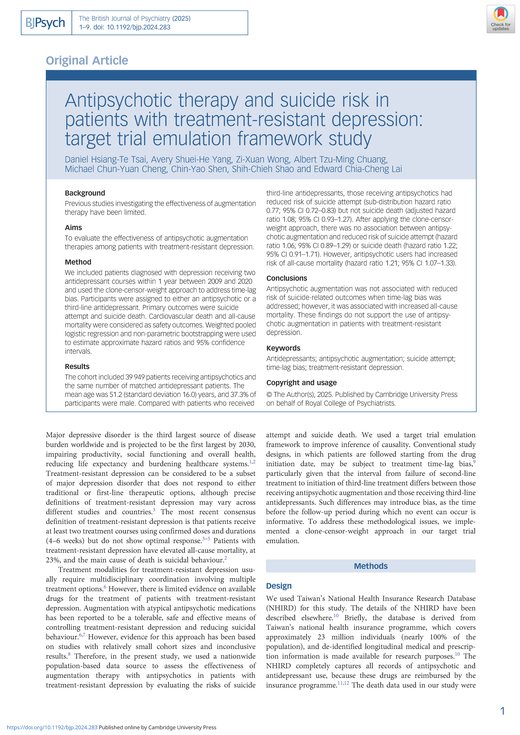
Latest study in the British Journal of Psychiatry
A target trial emulation across Taiwan's National Health Insurance data examining how antipsychotic augmentation relates to suicide risk in treatment-resistant depression.
Read the paper →Technical expertise
Statistical computing
- ▸SAS
- ▸Stata
- ▸SPSS
- ▸R
Methods
- ▸Comparative effectiveness
- ▸Causal inference
- ▸Target trial emulation
- ▸Self-controlled designs
Data
- ▸Claims databases (NHIRD, 20M+)
- ▸Electronic health records
- ▸Biomedical / registry linkage
Domains
- ▸Pharmacoepidemiology
- ▸Policy research
- ▸AI × geriatric medicine
RWE tools
Open-access utilities I build and maintain for real-world-evidence research — each runs right here on this site.
Protocol Generator
Build a publication-ready pharmacoepidemiology protocol (ACNU, case-crossover, descriptive, or self-controlled case-series) with a phenotype library that says which definitions carry a validation study, feasibility checks across Asian databases, and one-click Word / Markdown export.
Open the tool → Design InfrastructureProtocol Checker
The flip side of the generator: upload an existing protocol and get an AI-assisted, item-by-item read on whether it conforms to HARPER (the ISPE/ISPOR protocol template) or TARGET — with an auto-drawn study-design scheme, a planned-outputs review, and fixes for anything missing.
Open the checker → Analysis InfrastructureRWE Studio
Upload a small, messy hospital dataset and — entirely in your browser — profile and clean it into a tidy master file, map columns to a study design (with AI causal-covariate triage), and run the analysis in real R via WebR. Nothing is uploaded.
Open RWE Studio → RWE utilityPHDc RWE Toolbox
A real-world-evidence utility from the Population Health Data Center for exploring and operationalising claims-based study designs.
Launch the toolbox → Data InfrastructureNHIRD Data Dictionary
A searchable codebook for Taiwan's NHIRD and Health & Welfare Data Center datasets — variables, formats, and cross-dataset linkages, structured on the DIVERSE data-source framework.
Open the dictionary → Clinical toolACB Calculator
Scores a patient's total anticholinergic burden across 6 international scales and quantifies 30-day risk of cardiovascular events, pneumonia, and out-of-hospital cardiac arrest — with OCR drug-history capture and printable reports. Built on three Taiwan NHI studies (BMJ, Clin Epidemiol, Eur Heart J).
Open ACB calculator →Latest writing
All notes →Clone-censor-weight, explained: per-protocol effects without immortal-time bias
Most clinical questions are really about sustaining a treatment strategy, not just starting it — and that's exactly where naive analyses break. Clone-censor-weight is how you answer the per-protocol question honestly. Here's the intuition, in three moves.
Read →Target trial emulation: writing the protocol of the trial you can't run
Most “observational vs RCT” arguments aren't about the data — they're about a vague question. Target trial emulation forces you to specify the randomised trial you wish you could run, then emulate it component by component. Here's the protocol I write before touching the data.
Read →Open to collaborations
Multi-country RWE studies, methods work (target trial emulation, clone-censor-weight), or building research infrastructure — let's talk.